Choosing the Right Multispectral Sensor for Agriculture Research - AgEagle Camera Review
This blog was authored by Gary Nijak of AerialPlot, published on August 25, 2025. The original LinkedIn post can be found here.
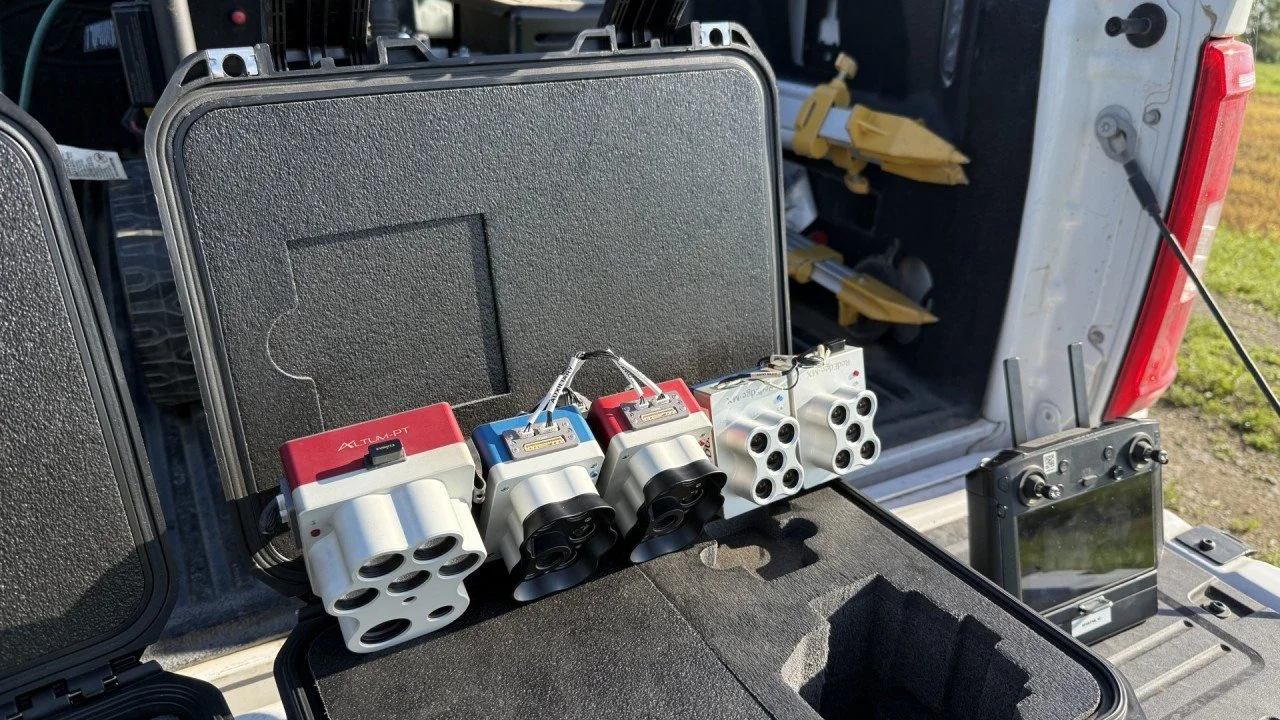
The AgEagle Altum-PT, RedEdge P Dual, and the RedEdge MX Dual on a sunny Minnesota morning getting ready to be put in the sky!
Field-Tested Camera Comparison: Altum-PT vs. RedEdge P Dual vs. RedEdge MX Dual
It’s not often that I have all of AgEagle Aerial Systems Inc.'s cameras in the office at the same time. Most of the time, they’re scattered across different deployments and projects. So, when the opportunity came up, I decided to conduct a side-by-side test that I hadn’t done before.
I flew the AgEagle Altum-PT, RedEdge P Dual, and RedEdge MX Dual over a small soybean plot at 200 ft (about 60 m) AGL, with 80% sidelap and a slower flight speed that pushed the frontal overlap closer to 90–95%. The site was flat, so there was no need for terrain correction.
The goal: to create an apples-to-apples comparison of these sensors under identical conditions.
Measured GSD vs. Published Specs
These numbers were what they were - no surprises here. (Note - I have included updated GSDs for two of the cameras. To generate the improved workflow numbers vs the published workflow, I followed all of the steps but I cleaned the point cloud in Agisoft and removed weak matches to improve the overall accuracy of the orthomosaic. This significantly improved the GSD of the cameras)
The Altum-PT should have produced ~1.25 cm/pixel at 200 ft, but my data came in at 2.66 cm/pixel using the published workflow. This discrepancy was most likely due to poor matches in Agisoft so I cleaned the point cloud, and then rebuilt the orthomosaic. This resulted in a GSD of 1.26 cm/pixel. Pretty much as advertised.
The RedEdge P Dual showed a similar story. Published specs suggest ~2.0 cm/pixel, but I measured 3.9 cm/pixel. Again, workflow settings can easily explain the difference so I reran using an improved workflow and got 2.06 cm/pixel, again, spot on.
The RedEdge MX Dual, on the other hand, matched expectations at ~4.27 cm/pixel, consistent with its published ~4.0 cm/pixel resolution at this altitude. I didn't bother to redo this stitch because the resolution was right as advertised.
Of particular note, there are lots of features in photogrammetry software such as Agisoft and Pix4D. Many times it can be straightforward to follow published workflows but there are a lot of considerations when trying to collect analytical quality data from multispectral drones and end up with a usable product. User caution is advised!
One other note on processing - there are known issues in Agisoft Metashape and Pix4DFields with the RedEdge P Dual that are not yet resolved (as of 8/15/2025). So keep an eye out if you are using this camera for artifacts that exist in the processing step.
Third note on processing - there is a lot that goes on under the hood for the panchromatic sharpening in both the Altum PT and the RedEdge P systems. Make sure, if it matters, you understand some of those intricacies because they can be important.
Performance Insights
Altum-PT
The Altum-PT remains the top performer in image quality. However, its massive data footprint makes it a challenge to manage. For small research plots, the volume is manageable, but in commercial operations, we’ve quickly burned through multiple 20 TB hard drives just trying to keep pace with the data storage and processing requirements. It does occasionally suffer from the missing photo but our high overlap situations don't seem to be impacted.
RedEdge P Dual
The P Dual is where things get interesting. We recently added the Blue camera to our existing Red setup, and that upgrade introduced some hardware and technical quirks that we’re still working through. Before that change, the single RedEdge P (Red) camera had been solid and reliable, and I expect the dual system will reach that same level once these issues are fully resolved.
RedEdge MX Dual
The MX Dual has been our workhorse for years. While its imagery doesn’t match the newer sensors in terms of raw resolution or quality, it’s reliable and consistent. And, to be clear, this is a 10-band system, so it’s not exactly low-complexity — but compared to the P and Altum platforms, it’s still more straightforward to manage in day-to-day workflows.
Unfortunately, the MX Dual is now end-of-life, which means no more support or repairs. That’s going to be a challenge for teams still relying on it as their primary multispectral solution.
Choosing the Right Sensor for Research
When it comes to research applications, the choice of sensor depends heavily on the question you’re trying to answer.
Altum-PT – Its thermal band gives it unique capabilities for research involving canopy temperature, crop stress, or water-use studies. However, its limited number of spectral bands makes it less ideal for building or validating broad-spectrum satellite models that require higher spectral resolution.
RedEdge MX Dual – Even though it’s now end-of-life, the MX Dual remains a versatile, reliable choice for most standard multispectral work. Its 10 bands cover a solid range of wavelengths, making it suitable for many vegetation indices and zone-specific profiling tasks without overcomplicating data management.
RedEdge P Dual – This system promises higher resolution and greater scalability for larger areas, but it still doesn’t quite hit leaf-level detail at typical flight altitudes. Additionally, while it’s strong for applications like spectral profiling and precision agriculture, it’s less ideal for architecture or structural questions where ultra-high-resolution imagery is needed.
In short:
For thermal research, Altum-PT stands out.
For general multispectral research, MX Dual often works best—when you can still get it.
For scalable spectral profiling, the P Dual is promising but still not fully optimized for certain advanced analytics.
Key Takeaways
Data Management Is Critical – Higher resolution and more bands mean exponentially larger datasets. At commercial scale, storage, processing power, and workflow efficiency quickly become pain points.
Real-World vs. Spec Sheets – Published numbers are a useful benchmark, but your processing choices and field conditions can have a huge impact on final outputs.
Reliability Matters – Raw performance is important, but when you’re flying high-volume missions, a stable, predictable system often outweighs marginal improvements in image quality.
Final Thoughts
This was a small-area test, so efficiency at scale wasn’t the focus. Even so, it provided valuable insights into how these cameras handle data capture, processing workflows, and operational reliability.
For now, the Altum-PT remains our niche for projects demanding the highest resolution and spectral range, though we’re mindful of the storage and processing demands and can only afford so many of these things with the >$15K price tag. The P Dual shows promise once its dual-band reliability issues are fully resolved, but again has a fairly high price point for the average researcher and may drive people towards a more integrated system such as the DJI Mavic 3 Multispec if it remains available. And the MX Dual — while aging — continues to prove that consistency and simplicity can still win the day.
For other questions, contact the folks at AgEagle. I'm not a sales person for them, but I have used their cameras a lot. I'm open to other systems, this is just the one we've used to data. But we're always testing others!
